
Content Marketing vs AI Content: Can Human Writers Still Beat ChatGPT?
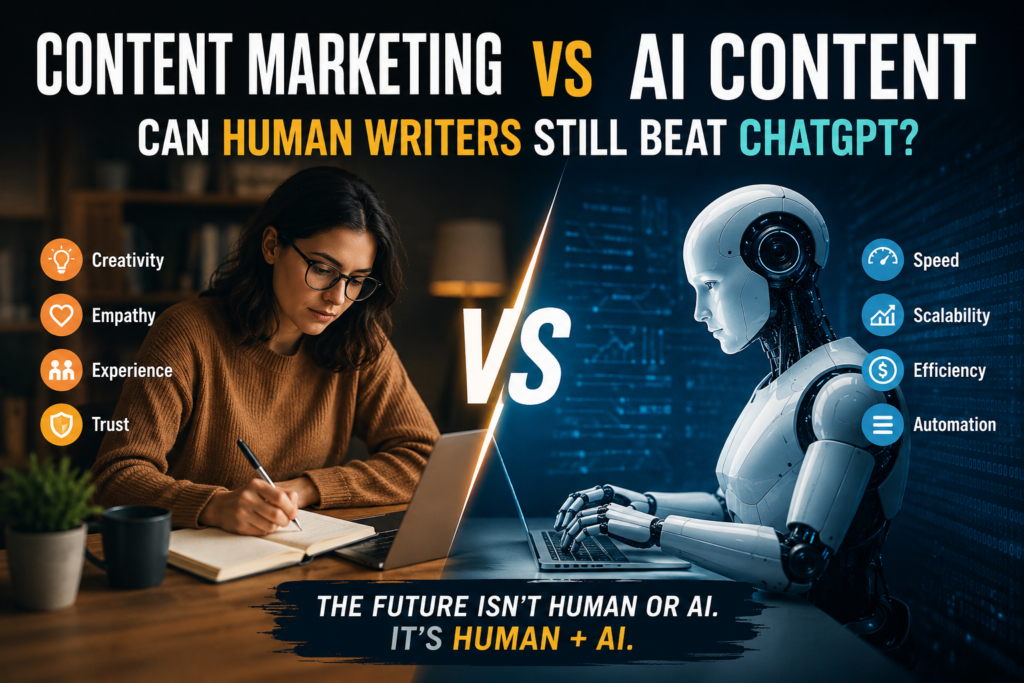
Artificial Intelligence (AI) has changed the digital marketing landscape in ways that were unimaginable just a few years ago. From automating customer support to analyzing consumer behavior, AI is helping businesses work smarter and faster. One area where AI has made a significant impact is content creation. Today, tools like ChatGPT and other AI-powered writing assistants can generate blog posts, email campaigns, social media captions, product descriptions, and even marketing strategies within minutes.
This rapid advancement has sparked an important debate among marketers, businesses, bloggers, and SEO professionals: Can AI replace human writers, or is human-written content still the better choice for successful content marketing?
The answer is more nuanced than simply choosing one over the other.
While AI offers speed, efficiency, and scalability, human writers bring creativity, emotional intelligence, critical thinking, and authentic storytelling—qualities that are difficult for machines to fully replicate. Understanding these differences is essential for businesses that want to build trust, improve search engine rankings, and create content that genuinely resonates with their audience.
In this blog, we’ll explore the differences between content marketing vs AI content, compare their strengths and limitations, and explain why the most effective content strategy in 2026 is often a combination of both.
What Is Content Marketing?
Content marketing is a long-term digital marketing strategy focused on creating and sharing valuable, relevant, and engaging content to attract a clearly defined audience. Instead of directly promoting products or services, content marketing aims to educate, inform, entertain, or solve problems for potential customers.
The goal is to build trust and credibility over time, encouraging readers to become loyal customers.
Content marketing can take many forms, including:
- Blog articles
- Website content
- Email newsletters
- Social media posts
- Videos
- Podcasts
- E-books
- Case studies
- Infographics
- White papers
Unlike traditional advertising, which focuses on selling, content marketing focuses on providing value first. Businesses that consistently publish helpful and informative content are more likely to establish themselves as industry authorities.
For example, if someone searches for “How to improve SEO rankings,” they are looking for useful information—not a sales pitch. A well-written blog that answers their questions builds trust, making them more likely to choose your business when they are ready to buy.
This customer-first approach is what makes content marketing one of the most effective digital marketing strategies today.
What Is AI Content?
AI content refers to written material generated by artificial intelligence using advanced language models. These models are trained on large datasets and can produce human-like text based on prompts provided by users.
AI writing tools can assist with:
- Blog writing
- Product descriptions
- Email marketing
- Social media content
- Landing pages
- Advertisement copy
- Video scripts
- SEO outlines
- Keyword suggestions
- Content summaries
One of the biggest reasons businesses are adopting AI is its ability to save time. Tasks that previously took hours can now be completed in minutes.
For instance, instead of spending an entire afternoon brainstorming blog ideas, marketers can ask an AI tool to generate multiple topic suggestions instantly. Similarly, AI can produce a first draft that writers can refine and personalize.
However, it’s important to understand that AI generates content by recognizing patterns in language. It does not think, feel, or possess firsthand experience. As a result, AI-generated content often requires human editing to improve originality, accuracy, and brand voice.
Content Marketing vs AI Content: Understanding the Difference
Although both human writers and AI can create written content, the process and the outcomes are often quite different.
Content marketing is built around understanding people—their problems, emotions, goals, and decision-making processes. Human writers use research, empathy, and experience to create meaningful content that builds long-term relationships.
AI, on the other hand, focuses on generating text quickly based on patterns it has learned from existing data. It excels at producing structured content efficiently but may struggle to provide unique perspectives or emotional depth.
Let’s examine the key differences.
1. Creativity and Original Thinking
Creativity remains one of the strongest advantages of human writers.
A skilled writer can combine personal experiences, industry knowledge, storytelling, humor, and emotion to produce content that feels fresh and memorable. Human writers can identify emerging trends, challenge conventional thinking, and offer original opinions that encourage readers to engage and share.
AI is capable of producing coherent and well-structured articles, but it typically relies on information patterns rather than original thought. Without careful editing, AI-generated content may sound generic or repetitive, especially when covering widely discussed topics.
For businesses looking to build a distinctive brand voice or establish thought leadership, human creativity continues to provide a significant advantage.
Winner: Human Writers
2. Speed and Productivity
When it comes to speed, AI has transformed content production.
A blog outline that once took an hour can now be generated in seconds. AI can draft articles, generate headlines, rewrite paragraphs, and create social media posts almost instantly.
This efficiency allows marketing teams to produce more content while reducing production costs.
However, speed should not come at the expense of quality. AI-generated drafts often need editing to ensure factual accuracy, improve readability, and align with the brand’s tone.
Human writers may take longer to complete an article, but they invest time in research, interviewing experts, verifying information, and refining ideas. This additional effort often results in richer, more authoritative content.
Winner: AI
3. SEO Performance
One of the biggest concerns among marketers is whether AI-generated content can rank well on search engines.
The answer depends on the quality of the content rather than the method used to create it.
Modern search engines prioritize content that satisfies user intent, demonstrates expertise, and provides genuine value. Whether the first draft is written by AI or a human is less important than whether the final article is accurate, original, and useful.
AI can assist with keyword integration, heading structure, readability improvements, and content organization. These features make it a valuable SEO assistant.
However, experienced human writers understand search intent, audience psychology, topical authority, and brand messaging in ways that AI cannot fully replicate. They know how to add examples, case studies, expert insights, and original analysis that make content more engaging and trustworthy.
The highest-performing content is often created through collaboration: AI handles repetitive tasks and drafting, while humans refine, fact-check, and enhance the final piece.
Winner: Human + AI Collaboration
4. Accuracy and Reliability
Accuracy is critical, especially when publishing content related to healthcare, finance, law, education, or technology.
AI tools occasionally generate information that sounds convincing but is incomplete, outdated, or incorrect. This is why relying solely on AI without verification can damage a brand’s credibility.
Human writers evaluate sources, cross-check facts, interpret data, and apply professional judgment before publishing. They can also identify inconsistencies and ensure the content reflects current industry standards.
Businesses that prioritize trust should always include a human review process before publishing AI-assisted content.
Winner: Human Writers