
Google Ads vs Meta Ads — Which One Should You Choose?
Google Ads vs Meta Ads But which platform is better?
In today’s digital-first business environment, simply having a website or social media account is not enough. Businesses need effective online advertising strategies to reach potential customers, generate leads, increase sales, and build brand awareness.
Two of the most powerful advertising platforms available today are Google Ads and Meta Ads.
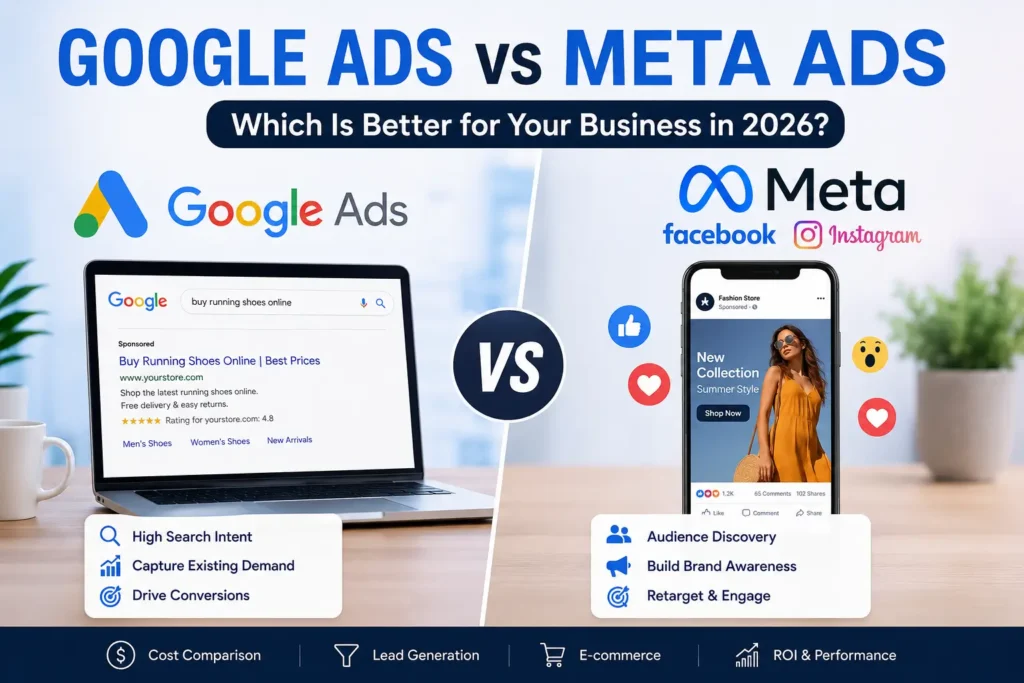
Google Ads allows businesses to reach people when they are actively searching for products, services, or solutions. Meta Ads, which includes advertising across platforms such as Facebook and Instagram, allows businesses to reach users based on their interests, behaviors, demographics, and online activity.
The answer depends on your business goals, target audience, budget, product, sales cycle, and marketing strategy.
In this guide, we will explore Google Ads vs Meta Ads, compare their targeting capabilities, costs, advantages, disadvantages, and ROI, and explain when you should use each platform.
What Are Google Ads?
Google Ads is Google’s online advertising platform that allows businesses to display advertisements across Google Search and other Google properties and partner inventory.
One of the biggest advantages of Google Ads is search intent.
Imagine someone searches:
“Best digital marketing course near me”
That person is already looking for a solution. A business offering digital marketing courses can display an advertisement for that search.
This makes Google Ads particularly powerful for businesses that want to capture high-intent customers.
How Google Ads Works
Google Ads generally operates through an auction system. Advertisers compete for opportunities to show their ads based on factors such as bids, relevance, ad quality, and other auction signals.
Depending on the campaign type, businesses can advertise through:
- Search Ads
- Display Ads
- Shopping Ads
- Video Ads
- App campaigns
- Performance Max campaigns
For businesses focused on immediate demand and conversions, Google Search Ads can be particularly valuable.
What Are Meta Ads?
Meta Ads are paid advertisements delivered through Meta’s advertising ecosystem, primarily including Facebook and Instagram.
Unlike Google Search Ads, Meta Ads are usually not based on someone actively searching for a particular product.
Instead, Meta can help businesses reach people based on factors such as:
- Demographics
- Interests
- Behaviors
- Engagement
- Location
- Custom audiences
- Website activity
- Previous interactions with a business
For example, imagine you sell premium fitness clothing.
A potential customer may not be searching for “buy gym clothes” on Google today. However, Meta Ads can help your business introduce your products to people who are interested in fitness, fashion, gym training, or related content.
This makes Meta particularly useful for discovery, brand awareness, audience building, and demand generation.
Google Ads vs Meta Ads: Key Differences
The biggest difference between Google Ads and Meta Ads is user intent.
Google generally captures existing demand.
Meta is often used to create or influence demand.
| Feature | Google Ads | Meta Ads |
|---|---|---|
| Main platforms | Google Search, YouTube, Display and others | Facebook, Instagram and Meta placements |
| Primary strength | Capturing search demand | Audience discovery and demand generation |
| Search intent | Very high on Search | Usually lower |
| Targeting | Keywords, audiences, location, etc. | Interests, demographics, behaviors, audiences |
| Visual content | Important for some campaign types | Extremely important |
| Best for | Leads, sales, high-intent searches | Awareness, discovery, leads, e-commerce |
| Retargeting | Available | Available |
| Shopping | Strong | Strong |
| Brand awareness | Good | Excellent |
| Keyword targeting | Core for Search campaigns | Not the primary targeting method |
Google Ads vs Meta Ads: Which Is More Cost-Effective?
One of the most common questions businesses ask is:
“Which is cheaper — Google Ads or Meta Ads?”
There is no universal answer.
Your advertising cost depends on your:
- Industry
- Competition
- Audience
- Location
- Ad quality
- Campaign objective
- Landing page
- Offer
- Conversion rate
- Budget
- Bidding strategy
The Google Ads cost can be higher in highly competitive industries because advertisers may compete aggressively for valuable search terms.
For example, keywords related to insurance, legal services, finance, and some professional services can be highly competitive.
Meta Ads can sometimes provide relatively inexpensive reach and clicks, especially when campaigns have strong creative content and effective audience targeting.
However, cheaper clicks do not automatically mean better results.
The real question should be:
How much does it cost to acquire a customer?
A campaign with a higher CPC can still be more profitable if it produces customers with a higher conversion rate and lifetime value.
Google Ads: Major Advantages
1. High Purchase Intent
One of the biggest benefits of Google Ads is the ability to reach people who are actively searching.
Someone searching for:
“Buy running shoes online”
has a stronger commercial intent than someone casually scrolling through Instagram.
This makes Google particularly powerful for businesses that already have existing market demand.
2. Excellent for Lead Generation
Google Ads can be highly effective for generating leads for:
- Real estate
- Education
- Healthcare
- Professional services
- Local businesses
- Financial services
- B2B businesses
3. Strong Keyword Targeting
Google Search campaigns allow advertisers to build campaigns around search queries and keyword themes.
This allows businesses to align advertisements with what potential customers are actively looking for.
4. Measurable Performance
Businesses can track important metrics such as:
- Clicks
- Impressions
- Cost per click
- Conversions
- Cost per conversion
- Conversion value
- Return on ad spend
This makes Google Ads a strong platform for performance-focused marketing.
Meta Ads: Major Advantages
1. Powerful Audience Targeting
Meta Ads are well known for their audience targeting capabilities.
Businesses can build audiences using information and signals such as:
- Age
- Gender
- Location
- Interests
- Behaviors
- Website visitors
- Customer lists
- Social media engagement
This can be especially useful for businesses selling visually appealing products.
2. Excellent Visual Advertising
Instagram and Facebook are highly visual platforms.
Businesses can use:
- Images
- Videos
- Reels
- Stories
- Carousels
- Product catalogs
to capture attention.
For fashion, beauty, food, travel, fitness, lifestyle, and e-commerce brands, this can be extremely valuable.
3. Strong Retargeting Opportunities
Suppose someone visits your website but doesn’t purchase.
You can use Meta advertising strategies to reconnect with eligible audiences based on their previous interactions.
Retargeting can help businesses move potential customers further through the purchasing journey.
4. Great for Brand Building
Meta Ads can introduce your brand to people before they are actively searching for your product.
This makes the platform useful for building awareness and creating future demand.
Google Ads vs Meta Ads for E-Commerce
For an e-commerce business, both platforms can be extremely useful.
Google Ads can capture people who are already looking for specific products.
For example:
“Men’s Hawaiian shirts online”
A relevant search ad or shopping-focused campaign can place your products in front of someone with clear buying intent.
Meta Ads, on the other hand, can introduce products through visually engaging content.
For example, a clothing brand can use an Instagram video showing:
- Product styling
- Different colors
- Product features
- Lifestyle shots
- Customer-generated content
This can generate interest even when users weren’t actively searching for the product.
The Best Strategy
Instead of thinking only about Google Ads vs Meta Ads, many e-commerce businesses should consider using both.
Meta can help generate awareness and demand.
Google can help capture existing demand.
Together, they can create a stronger full-funnel advertising strategy.
Google Ads vs Meta Ads for Lead Generation
For lead-generation businesses, Google Ads can be especially effective when potential customers are actively searching for a service.
For example:
“Digital marketing agency in Jammu”
or
“Best MBA coaching near me”
These searches indicate a specific need.
Meta Ads can take a different approach.
Instead of waiting for someone to search, you can show an offer to a carefully selected audience and encourage them to submit a form, send a message, or visit your website.
Therefore:
Google Ads = capture existing intent
Meta Ads = create and nurture interest
Both can work, but the right choice depends on your customer journey.
Google Ads vs Meta Ads: Which Has Better ROI?
ROI should not be judged only by clicks or impressions.
A successful advertising campaign should ultimately contribute to business outcomes.
Important performance metrics include:
Cost Per Lead (CPL)
How much you spend to generate one lead.
Cost Per Acquisition (CPA)
How much it costs to acquire a customer or completed conversion.
Return on Ad Spend (ROAS)
How much revenue is generated for every unit of advertising spend.
Conversion Rate
The percentage of users who complete the desired action after interacting with your advertising.
For example, Meta may generate 1,000 clicks at a relatively low cost, while Google may generate only 500 clicks at a higher cost.
If Google produces significantly more customers from those clicks, Google may deliver the better ROI.
The cheapest advertising platform is not necessarily the most profitable advertising platform.
Should You Use Google Ads or Meta Ads?
The best platform depends on your business model.
Choose Google Ads if:
- Customers actively search for your product or service.
- You want high-intent traffic.
- You primarily want leads or direct conversions.
- Your industry has strong search demand.
- You have landing pages designed for conversions.
Choose Meta Ads if:
- Your product is highly visual.
- You want to build brand awareness.
- You are launching a new product.
- Your audience can be identified through interests or behaviors.
- You have strong video or image creatives.
- You want to reach customers before they search.
Use Both if:
- You have enough budget to test multiple channels.
- You want a full-funnel marketing strategy.
- You sell products online.
- You want to combine demand generation with demand capture.
- You want to diversify your paid advertising channels.
How to Create a Successful Google and Meta Ads Strategy
Using both platforms successfully requires more than simply launching advertisements.
Step 1: Define Your Goal
Decide whether your goal is:
- Brand awareness
- Website traffic
- Lead generation
- Product sales
- App installations
- Customer acquisition
Your campaign objective should match your business goal.
Step 2: Understand Your Audience
Create a clear customer profile.
Identify:
- Who they are
- What problem they have
- What they want
- What motivates them
- Where they spend time online
- What objections prevent them from purchasing
Step 3: Create Strong Offers
A great advertisement cannot completely fix a weak offer.
Your offer should communicate a clear benefit.
For example:
Weak: “We provide digital marketing services.”
Stronger: “Get More Qualified Leads With a Data-Driven Digital Marketing Strategy.”
Step 4: Build High-Converting Landing Pages
Your landing page should match the advertisement.
Include:
- Clear headline
- Strong value proposition
- Relevant information
- Social proof
- Call-to-action
- Simple form or purchase process
Step 5: Test Your Campaigns
Never assume your first campaign will be perfect.
Test:
- Headlines
- Images
- Videos
- Audiences
- Keywords
- Offers
- Landing pages
- Calls-to-action
Then use performance data to make decisions.
Common Google Ads and Meta Ads Mistakes
Many businesses waste advertising budgets because of poor campaign management.
Some common mistakes include:
1. Targeting Everyone
A broad audience isn’t always a better audience.
2. Using Weak Creative
Especially on Meta, your creative can determine whether someone stops scrolling.
3. Ignoring Conversion Tracking
Without accurate tracking, it becomes difficult to know which campaigns are actually generating business results.
4. Sending Traffic to Poor Landing Pages
Getting clicks is not enough. Your website must convert those visitors.
5. Optimizing for the Wrong Metric
A campaign shouldn’t be considered successful simply because it has a low CPC.
Always connect advertising metrics with actual business outcomes.
Google Ads vs Meta Ads: Final Verdict
So, Google Ads vs Meta Ads — which one is better?
There is no single winner.
Google Ads is particularly powerful for capturing existing customer intent, while Meta Ads is particularly powerful for audience discovery, visual advertising, brand awareness, and demand generation.
If your customers are actively searching for your products or services, Google Ads may be the stronger starting point.
If you need to introduce a product, build awareness, or reach people based on audience characteristics and interests, Meta Ads may be a better fit.
For many modern businesses, however, the strongest strategy isn’t choosing one platform.
It’s using Google Ads and Meta Ads together.
Meta can help people discover your brand.
Google can help capture people who are ready to take action.
When combined with strong creative, accurate conversion tracking, compelling offers, optimized landing pages, and continuous testing, both platforms can become powerful parts of a successful digital advertising strategy.
Conclusion
The world of online advertising is constantly changing, but the fundamentals remain the same: understand your audience, offer genuine value, track meaningful results, and continuously optimize your campaigns.
Whether you choose Google Ads, Meta Ads, or both, focus less on vanity metrics and more on profitable customer acquisition.
The goal isn’t simply to get more clicks.
The goal is to turn advertising spend into sustainable business growth.